
Newsletters
Conferences and Events
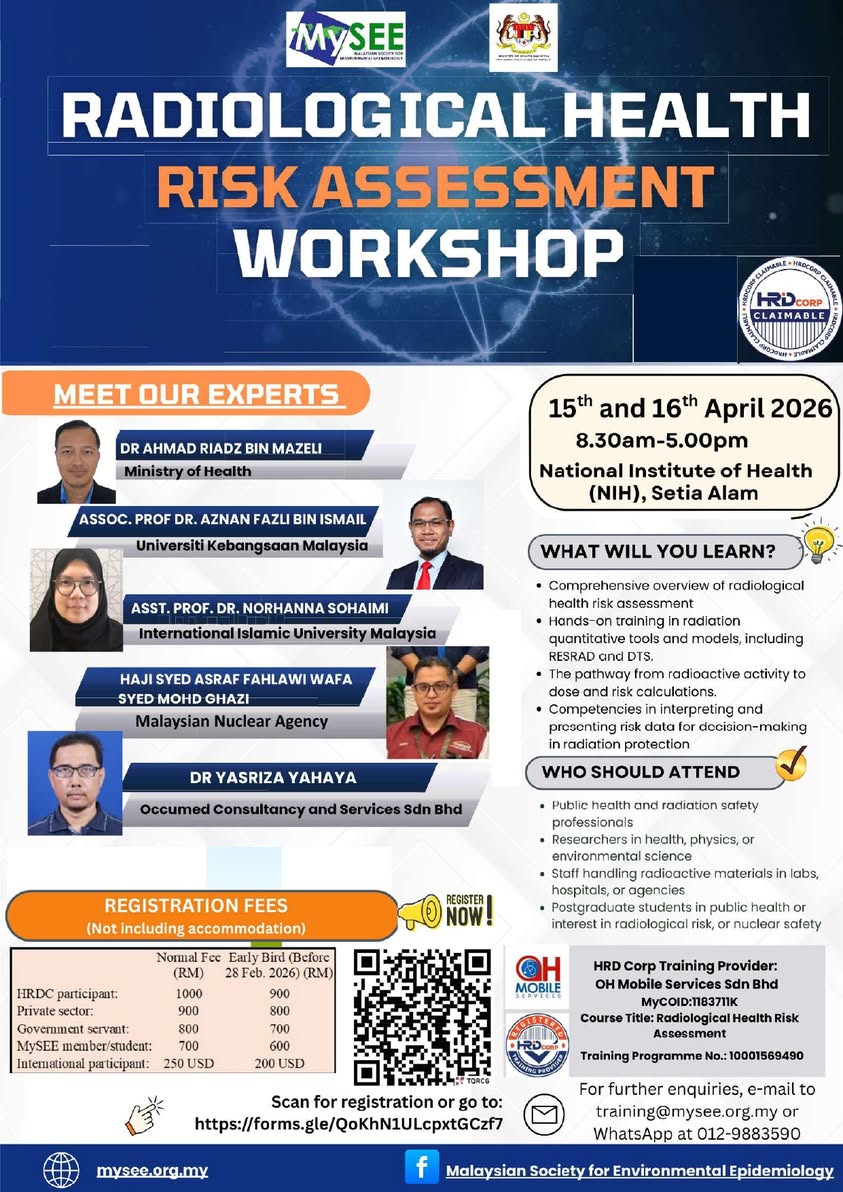
Radiological Health Risk Assessment Workshop 2026 in Kuala Lumpur, Malaysia
The Malaysian Society for Environmental Epidemiology (MySEE) will organise a Radiological Health Risk Assessment Workshop on 15–16 April 2026 at the National Institute of Health (NIH), Setia Alam, Malaysia.
This two-day, in-person training provides a comprehensive and practical overview of radiological health risk assessment. Participants will gain hands-on experience using quantitative assessment tools, including RESRAD and DTS, and learn the full pathway from radioactive activity to dose estimation and risk calculations. The workshop also focuses on building competencies in interpreting and communicating radiological risk data to support policy, regulatory, and public health decision-making.
Experts from the Ministry of Health Malaysia, Malaysian Nuclear Agency, universities, and industry partners will contribute to the programme.
Registration: https://docs.google.com/forms/d/e/1FAIpQLSfvk0zeGCQDayZ_S94L5LkGWxmBLWyctXIZeDBEOK4Z03ICEA/viewform
Website: https://mysee.org.my
Email: training@mysee.org.my
Facebook : Malaysian Society for Environmental Epidemiology

ISEE AWPC 2026 in Bangkok, Thailand
We are delighted to announce that the 2026 ISEE-AWPC Conference will be held in Bangkok, Thailand on December 15-16, 2026, with a pre-conference workshop on December 14.
More details will be shared soon! Stay tuned!
Research Highlights
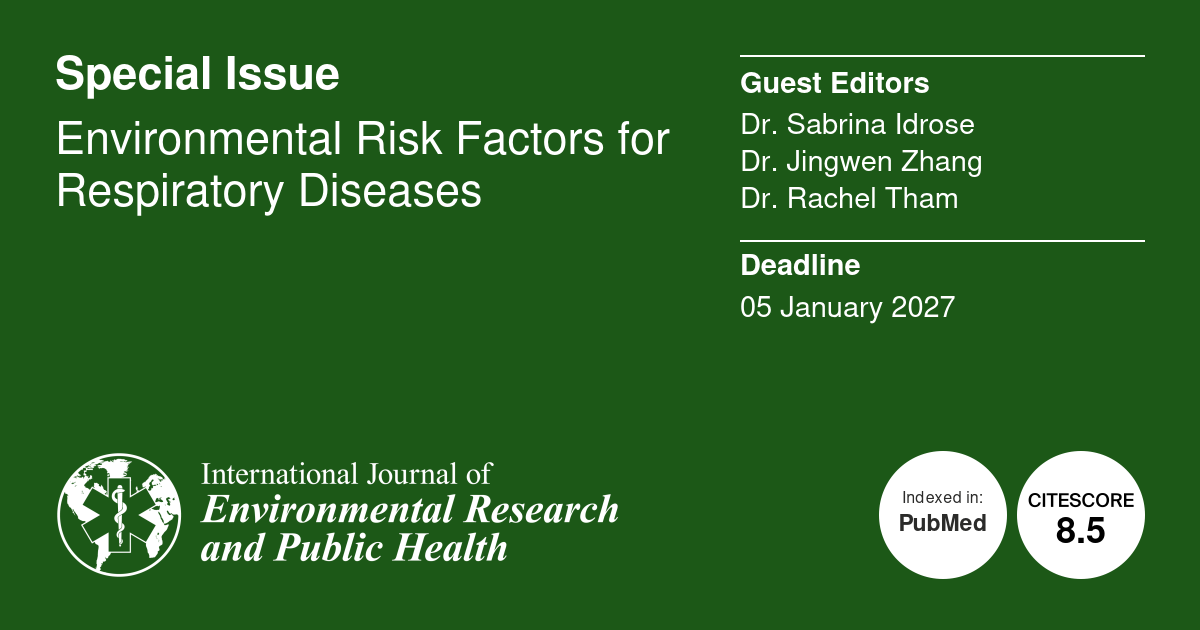
Call for Papers - Special Issue: Environmental Risk Factors for Respiratory Diseases by the
International Journal of Environmental Research and Public Health (IJERPH)
Guest Editors: Dr. Sabrina Idrose, Dr. Jingwen Zhang, Dr. Rachel Tham
We invite submissions examining environmental exposures across the life course and their impact on respiratory health, including air pollution, aeroallergens, climate-related exposures, occupational risks, and susceptibility factors.
Submission deadline: 5 January 2027
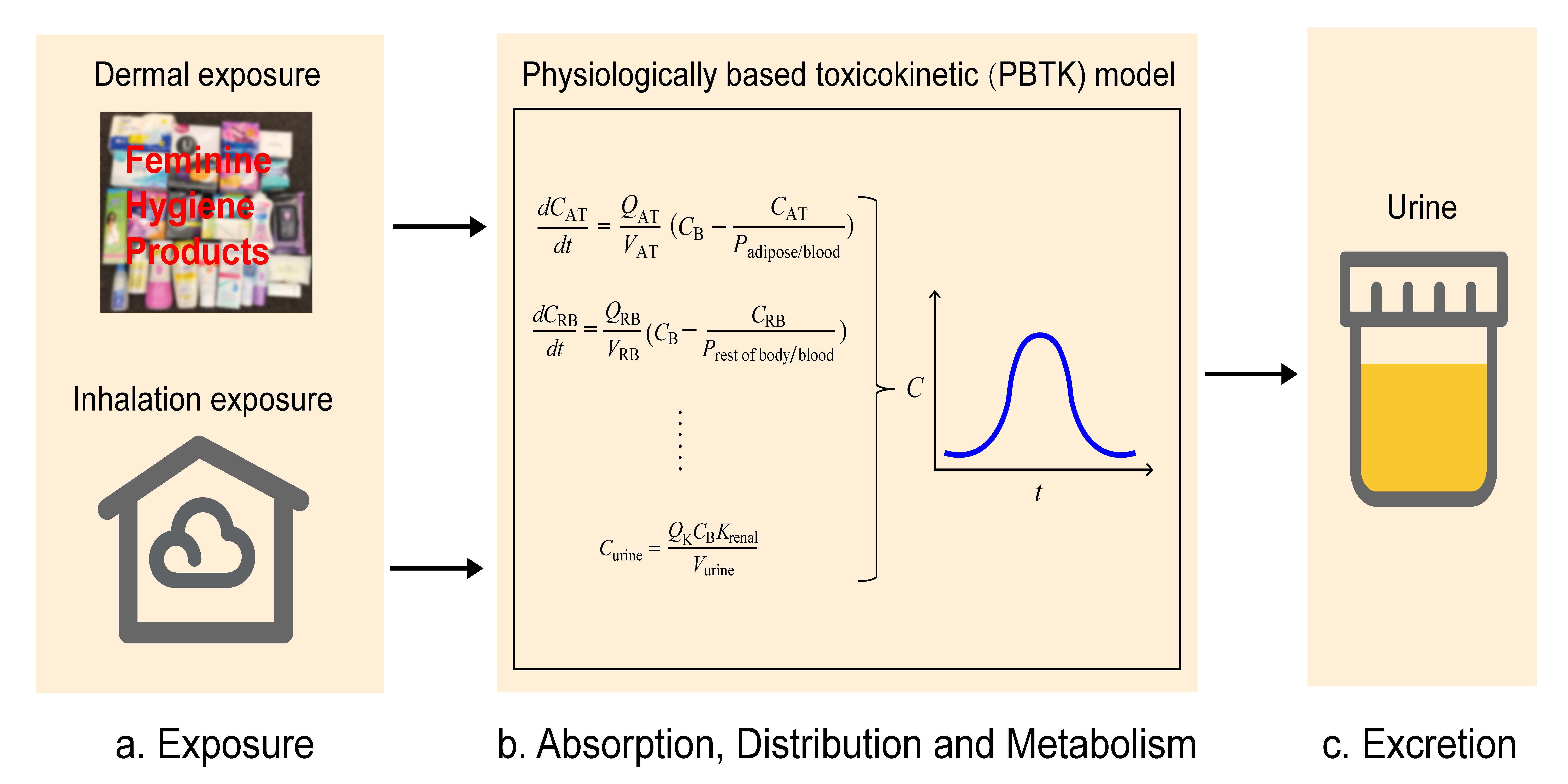
Publication - Hidden Chemical Exposure from Feminine Hygiene Products Raises New Health Questions
Dr. Nan Lin and colleagues recently published a paper in Environmental Health Perspectives which investigates how volatile organic compounds (VOCs) from feminine hygiene products (FHPs) are absorbed and distributed in the human body. Researchers measured VOCs in common products and applied a physiologically based toxicokinetic (PBTK) model to estimate internal exposure following dermal contact. The study found that most VOCs are rapidly absorbed through the skin, with concentrations in blood and organs peaking within about one hour of use. Although nearly 80% of absorbed VOCs were eliminated via liver metabolism, exhalation, and urine, lipophilic compounds such as p-cymene, hexane, and n-nonane showed a tendency to accumulate in adipose tissue, reaching levels far higher than in other tissues. The findings emphasize dermal exposure as an overlooked pathway and highlight the need for more comprehensive risk evaluation of chemicals in everyday personal care products.
Publication - Climate change and burden of foodborne infections in Australia
A recent study estimated the burden of Salmonellosis and Campylobacteriosis attributable to non-optimal temperatures across Australia and found that substantial proportion of enteric infections is attributable to non-optimal temperatures. It also shows that higher warming scenarios result in increased future burden. Population growth amplifies total attributable cases. Adaptation reduces projected impacts but does not fully offset climate-driven increases.
Foodborne infections are climate-sensitive and likely to increase under continued warming. Temperature-related risk extends beyond heat mortality to infectious diseases. Forward-looking health planning must integrate climate projections and demographic change.
This work advances evidence on climate-sensitive infectious diseases and supports data-driven public health planning under future warming scenarios.

Publication - Neighborhood-Level Heat Vulnerability Mapping to Inform Climate Adaptation in Jodhpur, India
Dr Rachit Sharma and colleagues recently published a ward-level Heat Vulnerability Index (HVI) for Jodhpur, Rajasthan—one of India’s hottest and rapidly urbanizing cities. Using publicly available socio-demographic and environmental data, we integrated exposure, sensitivity, and adaptive capacity indicators to identify hyperlocal disparities in heat risk. Our analysis revealed substantial variation across the city’s 80 wards, with approximately one-third classified as highly vulnerable. Sensitivity was shaped by child population, gender, and marginalized caste groups, while adaptive capacity was influenced by literacy, healthcare access, green cover, and water resources. The findings aim to directly inform Jodhpur’s Heat Action Plan and demonstrate how equity-centered, neighborhood-level assessments can strengthen climate adaptation planning in South Asia.
Resources

Webinar series - Low-Cost Air Quality Sensors Training Series for South Asia
Countries in South Asia experience high levels of air pollution, and efforts are underway to expand air quality monitoring and strengthen local capacity to generate data and evidence.
The Health Effects Institute (HEI) recently delivered a five-part webinar series (January–February 2026) on the use of low-cost sensors for air quality monitoring, aimed at early-career researchers in South Asia. The series covered sensor technologies, siting and network design, data management and analysis, maintaining large sensor networks, and global best practices.
The training aimed to build research capacity in low-cost air quality monitoring and share lessons from large sensor networks and ongoing projects in South Asia and other low- and middle-income countries.
All sessions were recorded and are available along with presentation slides on the HEI website, with a YouTube playlist created for easy access. For enquiries, please contact Abinaya Sekar (asekar@healtheffects.org).